Turning a ticket-reduction request into a full governance rebuild
A legacy access system with no self-service path and 700+ monthly tickets was rebuilt end-to-end — validating an 81% ticket drop and cutting the active user base by 86% in Beta. This project is covered by an NDA: screens and prototypes are not shown, so the case study focuses on process, decisions, and impact.
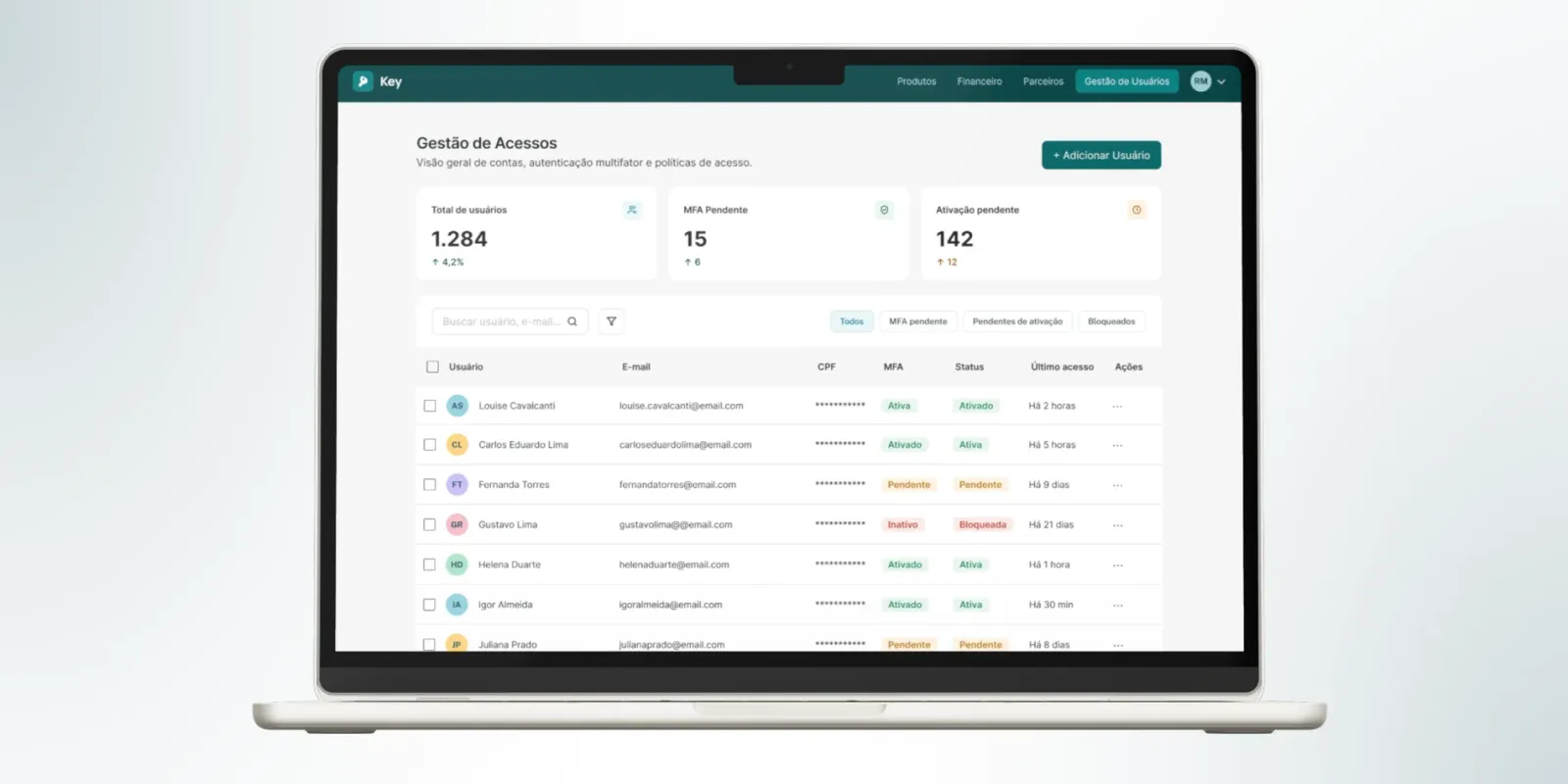
NDA notice
This project is covered by an NDA — screens and prototypes are not shown. This case study focuses on process, decisions, and impact. Company name and identifying details have been omitted or altered.
The problem
Access management wasn’t a UX gap — it was 700+ monthly tickets with zero self-service path.
None of these sat in isolation. The legacy system had no self-service path, so every reset went through a support agent — and without unique accounts, MFA couldn’t be enforced across the base.
An incoming Customer Portal migration turned this into “rebuild now,” not “patch later.”
No self-service option: a minimum of 700 monthly tickets tied to access requests, all handled manually.
Shared emails blocked MFA enforcement: across the base — a structural security gap, not an edge case.
An incoming Customer Portal migration: required a full credential rebuild before it could even start.
My role
I led design strategy end-to-end, from business case through Beta — leading a two-person design team and aligning a three-person engineering squad.
Business case: structured the case that secured a dedicated engineering squad.
Research strategy: set under a hard constraint: no direct access to end users.
Scope & direction: directed scope, and guided the wireframes and prototypes delivered by the design team.
Cross-team alignment: owned alignment with Security, D&A, Product, Engineering, Sales, and Support throughout the project and the Beta release.
Scope
Self-service Portal · MFA rollout · access governance & data hygiene.
Discovery
With end-user testing off the table, discovery leaned on benchmarking, empathy mapping, and reseller interviews to de-risk every decision.
Direct access to end users wasn’t on the table, so discovery had to earn confidence through other means.
Competitive benchmark: across four established SaaS platforms known for access and permissions UX.
Empathy maps and user journeys: built by walking through real processes in the existing tool.
Historical support ticket analysis: which directly shaped scope.
Reseller interviews: with the company’s three largest resellers — access requests were a recurring, unresolved pain, described as “a routine that never ended.”
User stories: derived from those journeys.
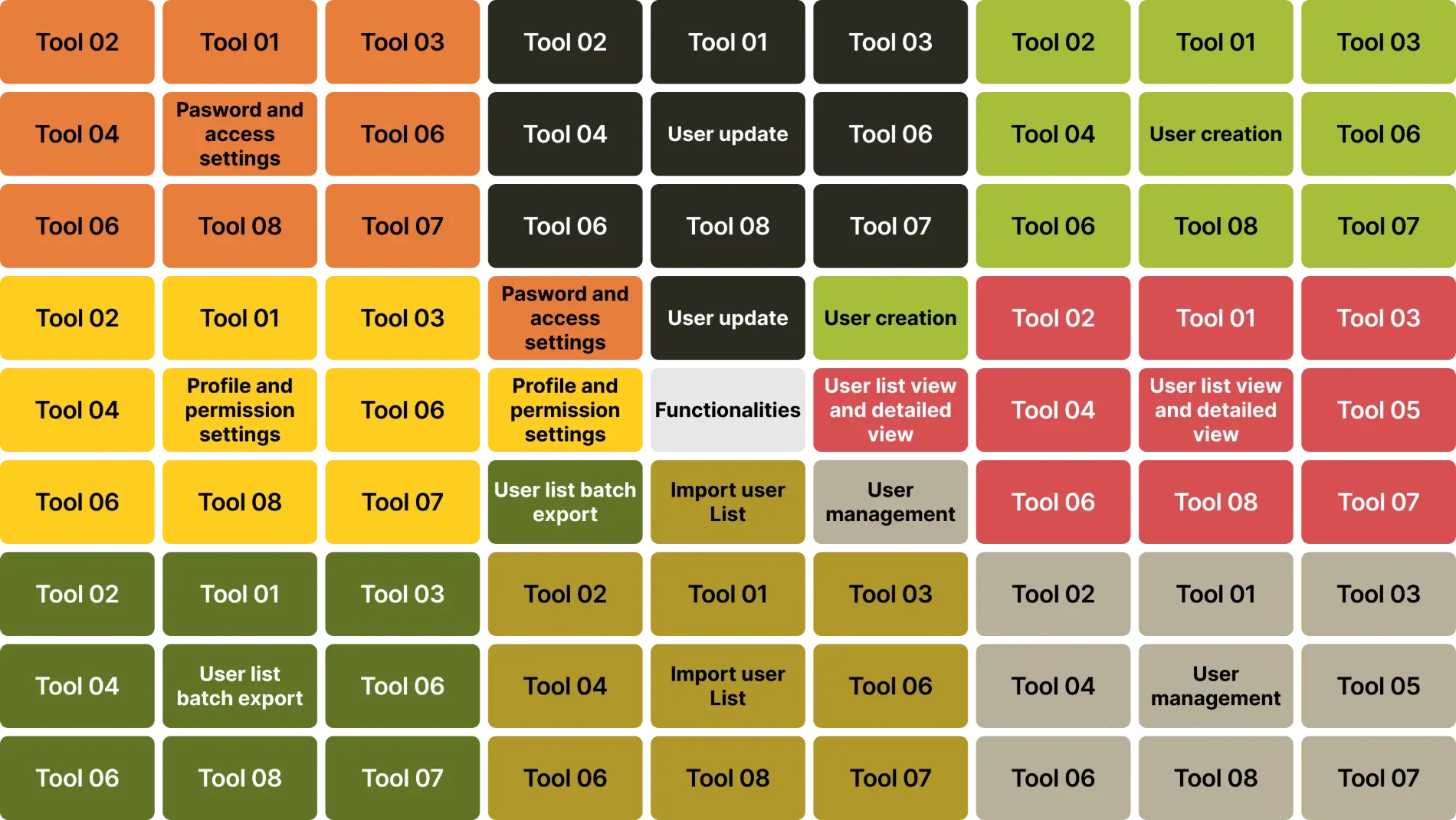
“Lotus blossom” sessions: to structure and prioritize core platform elements.
Design principles
Five principles guided the permission-model decisions that followed.
Model real organizational hierarchy, not abstract permission levels: many client accounts run their own internal structure — headquarters and branches/subsidiaries — so the three tiers map directly onto it: Admin Master oversees the account, Admin governs a group or branch, General User consults. That’s what let one model serve a single-location client and a multi-branch client alike, without a redesign per client type.
Match the destination system’s mental model, not just the current one: mirroring the future Customer Portal meant users would carry one mental model through migration, instead of learning access twice.
Build for real usage, not theoretical granularity: the system could technically support far more segmentation than clients actually used — ticket data and reseller interviews ruled that out, not intuition.
Invest self-service where the ticket pain actually lives: request volume, not feature parity, decided where to spend the investment.
Cut deliberately, not by default: every feature removed from scope traced back to evidence that almost no one needed it — not to time pressure alone.
Strategy
We deliberately simplified: four possible permission models became three tiers, mirroring the future Customer Portal so migration wouldn’t force anyone to relearn access.
Three permission tiers instead of the four originally mapped: Admin Master (manages all users and permissions across the account), Admin (manages users within their own groups), and General User (product consultation only). Tiers were modeled directly on the future Customer Portal’s structure — the definition was shared with the migration team and helped shape their own access model.
Admin Master
Oversees the account as a whole — all users and permissions, across every group.
Admin
Governs a single group or branch, managing the users inside it.
General User
Consults products only — no user or permission management.
The tier model had to satisfy three things pulling in different directions at once: what was ideal for how clients are actually organized — many operating with headquarters and branches, needing someone overseeing everything, someone managing their own group, someone just consulting; what the current system could technically support, which per the ticket and reseller data was more granularity than anyone actually used; and what the future Customer Portal would support after migration, which meant the tiers had to be simple and structured closely enough that migrating users wouldn’t relearn access from scratch.
Three tiers sat at the intersection of all three — not the ceiling of what was technically possible, and not a guess at what users might someday want.
Why three, not more: The system could support far more granular segmentation than clients actually used — ticket analysis and reseller interviews showed no demand for it. And matching the destination tool meant users carried the same mental model through migration, instead of learning access twice.
What we traded off: Per-user product configuration was cut — individual product-level permissions couldn’t be supported within the tier model. Self-service group creation was cut too and kept as a support-assisted flow: request volume for new groups was far lower than for new users, so we spent the self-service investment where the ticket pain actually was.
Governance
Rolling out the tier model wasn’t a single release. Accounts were segmented by usage and client type into a risk-based tiering model, then rolled out in phases — each wave signed off by commercial teams, customer support, and senior leadership.
Interface showcase
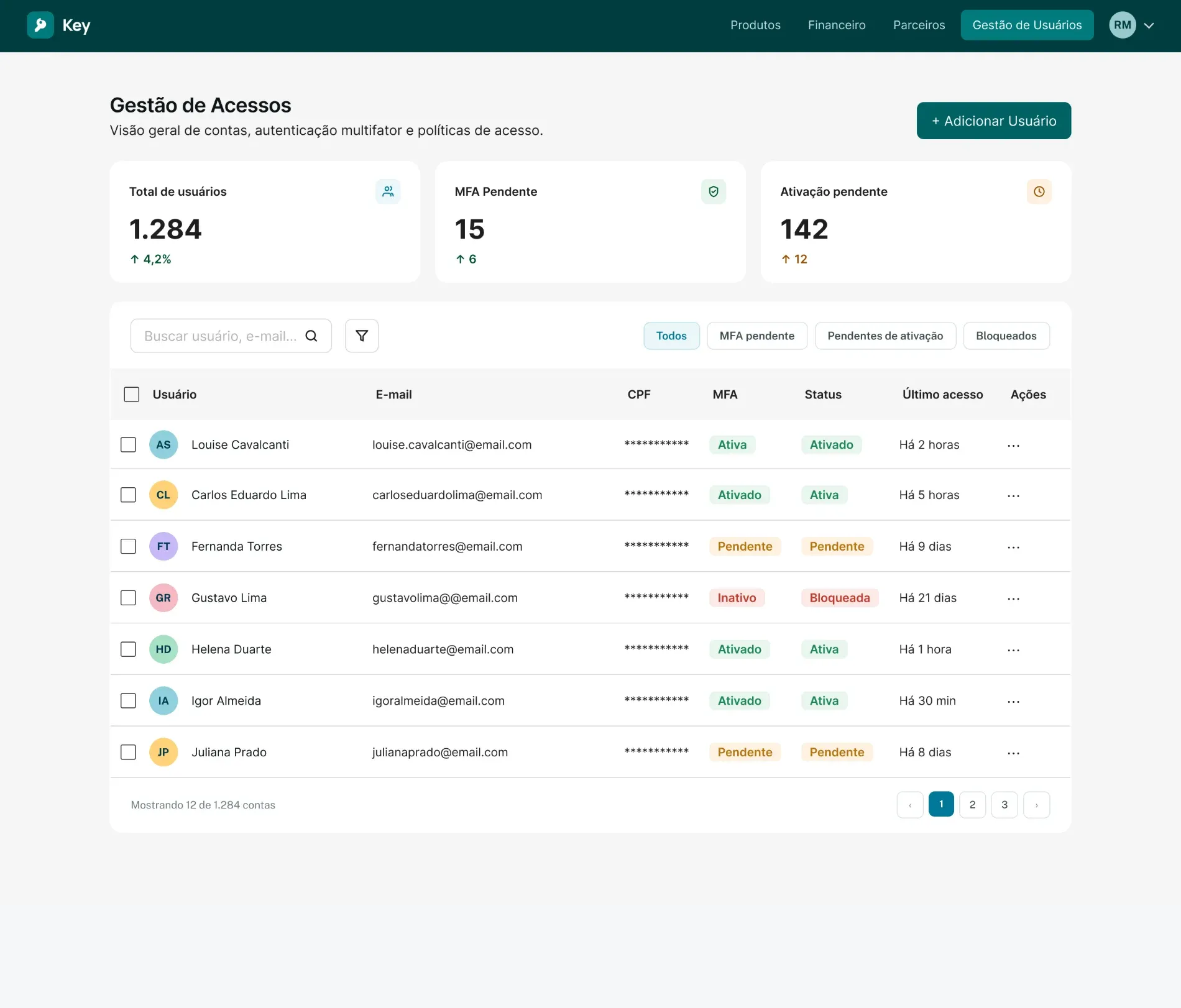
What shipped in the Self-Service Portal.
Self-service user management: create, edit, bulk actions, and CSV export — without a support agent in the loop.
Password reset and MFA: activation and reset, available directly to admins.
Three permission tiers: modeled after the future Customer Portal.
Reseller tools: to manage their own downstream client accounts.
Before / after
Four structural swaps.
No self-service path — every reset went through a support agent: became self-service user management: create, edit, bulk actions, CSV export.
Shared emails blocked MFA enforcement: became MFA activation and reset, built and available across the base.
700+ manual access tickets per month: became an 81% drop in access ticket volume in Beta.
260k unmanaged, ungoverned user accounts: became 36k users under a risk-based tiering model (-86%).
Outcomes
Beta results beat the ticket-reduction target by 6 points, while MFA and email-uniqueness adoption continue to phase in.
Across the three companies in Beta, ticket volume dropped consistently — a strong early signal that the self-service model holds up in real usage, not just in projection.
Built vs. adopted
MFA and email-uniqueness capabilities were fully built and available in the product. Full adoption is phasing in on an internal governance timeline, independent of the product itself.
Reflection
The hardest part wasn’t building the tool — it was leading alignment across teams while the business itself kept changing.
Scope kept growing: The initiative expanded every time the business around it changed — a support fix became a complete cross-team governance initiative.
Two problems, one timeline: We were fixing today’s operational pain while designing for a Customer Portal that didn’t exist yet. That meant cutting features the current system technically allowed — per-user product configuration, self-service group creation — because carrying them forward would burden the migration with complexity that ticket data showed almost no one needed.
Alignment was reactive: Short roadmaps in partner teams meant leading through constant renegotiation, not a fixed plan.
"A ticket-reduction request was the symptom. Governance was the product."
Closing thought
Let's talk